The Imperative of Courageous Leadership
Why the World Needs Leaders Who Choose Truth Over Approval
There is a quiet crisis in our organizations, our institutions, and yes—our world. It’s not a crisis of intelligence, talent, or resources. It’s a crisis of courage.
Everywhere you look, you’ll find leaders who are well-versed in the art of agreement. They smile, they nod, they smooth the rough edges of dissent and weave consensus from threads of comfort. They are the “yes” people—the agreeable, the accommodating, the ones who keep the boat steady, but rarely, if ever, rock it.
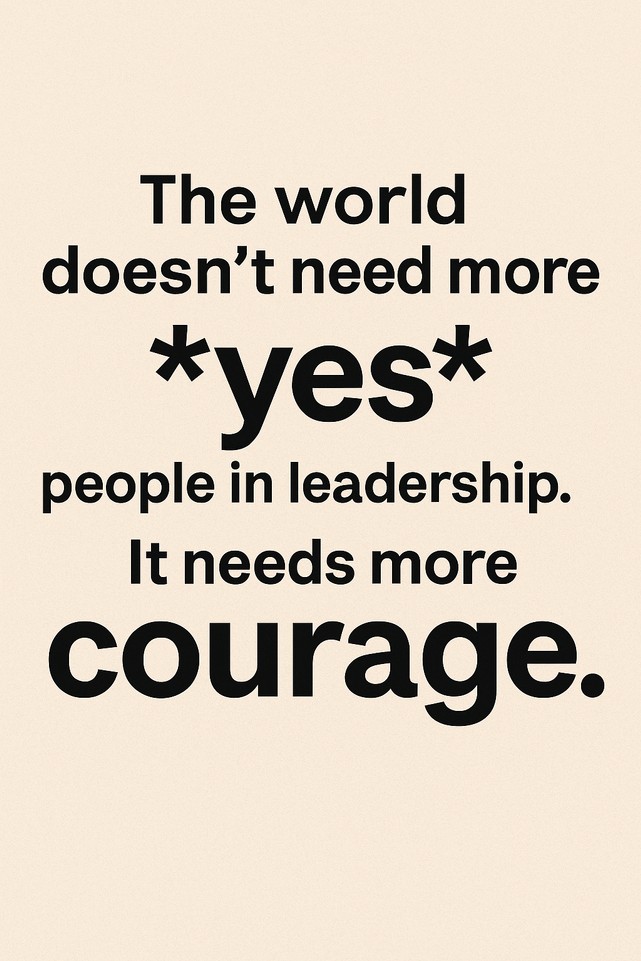
But the world doesn’t need more “yes” people in leadership. The challenges we face—complex, urgent, and unyielding—demand something altogether different. They call for leaders who are bold enough to risk discomfort, who would rather speak the inconvenient truth than court applause, who understand that meaningful progress is almost always upstream from consensus.
The world needs courageous leaders.
The Price of Passive Leadership
Passive leadership comes with a hidden, but devastating, cost. When leaders trade truth for approval, when they remain silent to stay safe, the consequences ripple far beyond the boardroom.
- Trust Erodes: People see through empty affirmations. When a leader’s words are always agreeable, never challenging, teams start to wonder if anything real is being said at all. Trust, that fragile currency of effective teams, is squandered for the fleeting warmth of approval.
- Innovation Stagnates: Innovation is born of friction—disagreement, debate, the clash of ideas. When leaders discourage dissent or smother all conflict with premature harmony, the creative spark dies. The organization settles into the comfort of “the way we’ve always done it,” while the world moves on.
- Toxicity Thrives: In the absence of courageous leadership, toxic behaviors go unchallenged. Gossip, favoritism, unethical decisions—these are protected by silence and enabled by leaders who won’t risk a confrontation. The rot spreads.
- Good People Leave: The most talented, values-driven people do not want to work where their voices aren’t heard, or their integrity isn’t valued. In passive cultures, they vote with their feet. What remains can be mediocrity, or worse—those who rise are skilled at navigating politics, not driving progress.
Passive leadership doesn’t just maintain the status quo; it actively undermines the possibility of change.

The Anatomy of Courageous Leadership
What does it mean to lead with courage? It’s easy to picture courage as brazen defiance or dramatic confrontation. In reality, courageous leadership is typically quieter, often lonelier, and always principled.
- It’s saying no when it’s easier—and safer—to nod along.
- It’s speaking truth to power, even when your voice shakes or your hands tremble.
- It’s standing for values, not hiding behind politics or the shifting sands of popular opinion.
- It’s protecting people—especially the vulnerable or the voiceless—even if it means displeasing those higher up the chain.
Perhaps most of all, courageous leaders are willing to be wrong. They invite dissent, knowing that robust disagreement is the crucible in which the best ideas are forged. They own their mistakes, not just their victories. They are less interested in looking perfect, more interested in being real.
What Courage Looks Like, Practically
Courage in leadership is not about being loud, brash, or relentlessly confrontational. It is about being anchored in principle, even when it’s inconvenient. It’s about having the inner strength to act, not just react.
- Challenging decisions that don’t sit right, even in the boardroom—especially in the boardroom.
- Advocating for the unheard, even if it means standing alone.
- Taking ownership when things go wrong, stepping forward to accept responsibility when others hide.
- Making space for disagreement—not as a threat, but as an essential ingredient for growth.
Yes, this kind of leadership is risky. It opens the leader to criticism, misunderstanding, and sometimes even professional peril. But the alternative is far costlier: the slow decay of trust, the dimming of boldness, the loss of what makes an organization—and its people—great.
The Ripple Effects of Courage
When leaders are courageous, it doesn’t just change the leader—it transforms the culture. Courage is contagious. When a leader says, “That’s not right. Let’s do better,” it gives everyone else permission to do the same.
- Teams that trust their leaders to speak up are more likely to speak up themselves. Psychological safety grows, and with it, innovation and collaboration.
- Organizations that reward courage over compliance attract and retain the very best people. Diversity of thought flourishes, and everyone’s best work emerges.
- And, crucially, courageous leadership challenges toxicity, stamping out the behaviors that corrode culture and drive away talent.
This is leadership that doesn’t just keep the peace but changes the game entirely.

The Path Forward: Choosing Courage Over Comfort
We live in a world that rewards polish, that prizes followers who don’t make waves. But the times demand something braver. They demand leaders who are willing to risk discomfort for the sake of truth, who see disagreement not as disloyalty but as a sign of engagement and care.
If you’re a leader—whether you have a title or not—the question is not whether you want to be liked. The question is whether you’re willing to be trusted, respected, and, when necessary, challenged. Are you willing to lead with courage—or just keep the peace?
Your team, your company, your community—they aren’t waiting for more polished followers. They’re waiting for bold, imperfect, values-driven leaders who will stand up and say:
> “That’s not right. Let’s do better.”
This is a call to every leader who feels the tension between comfort and courage: choose courage. Say no when it matters. Speak up when it counts. Stand for your values, every time. Protect your people, even if it means going against the grain.
Leadership is not about being the loudest voice in the room, or the one with the most agreeable smile. It is about being the steady hand, the clear voice, the one who stands when others hesitate. It is about having the courage to lead—truly lead—when it matters most.
Be one of them. The world is waiting for you.